
News

In Memoriam | Carol Terrillion

It is with the heaviest of hearts that I must inform everyone of the passing of Ms. Carol Terrillion, CIL Program Coordinator. Carol was an advocate through-and-through and lived her life to the fullest, never letting disability dictate what she could or couldn’t do.  Indeed, this was the lesson Carol taught all of us everyday.

In recent years, Carol ran our youth program in Marion County where many students had the great fortune of learning so much from her.  Carol’s example was one of survival.  She had a natural instinct to fight for a certain kind of life that was full with satisfaction and success.  She so loved her family and her daughters and grandchildren were her joy. We will all miss Carol, always.

Services are being arranged by Hiers-Baxely Funeral Services.
http://www.hiers-baxley.com/obituaries/Carol-Terrillion/#/Obituary 

Florida’s way: Nursing home profits trump sick kids’ special needs | Fred Grimm The Miami Herald

The feds just don’t understand how we do business down here in Florida. The Department of Justice’s Civil Rights Division fired off a letter to the state attorney general’s office last week, threatening to sue the state for sticking medically fragile kids in geriatric warehouses.

Apparently the feds regard these individual as mere children. In Florida, they’re considered the very cogs that keep the state’s faltering nursing home industry humming along. They’ve been privatized.

The letter from Assistant U.S. Attorney General Thomas E. Perez charged that the state was failing to provide the appropriate community-based services required by the Americans with Disabilities Act.

“Hundreds of children are currently segregated in nursing facilities throughout Florida,” Perez wrote. “They are growing up apart from their families in hospital-like settings, among elderly nursing facility residents and other individuals with disabilities. They live segregated lives — having few opportunities to interact with children and young adults without disabilities or to experience many of the social, educational and recreational activities that are critical to child development.”

If the feds come down to Florida with some outlandish notion that the welfare of young Medicaid recipients ought to trump business interests, then, sure, the situation will sound like a Dickensonian nightmare. Perhaps Perez didn’t realize it, but the reason we consign kids to old folks’ homes was explained right there on Page 6 of his 22-page letter.

“During our investigation we learned that … the state has overseen the placement of hundreds of children into nursing facilities. For a majority of the children referred to these facilities, the state pays an enhanced rate of over $500 per day per child, which is more than double what the facility receives from the State to serve elderly individuals and other adults.”

There you have it. Double the reimbursement. Nursing homes may not be so good for the children, who could be cared for at home as out-patients, probably for less money, but children are very good for nursing homes.

Back in March, a coalition of advocates filed suit against Florida’s Agency for Health Care Administration claiming that AHCA had illegally warehoused some 250 fragile children in adult nursing homes and was pressuring the parents of some 3,500 others now receiving treatment at home to move their kids into geriatric facilities.

The charges looked even more unseemly next to a report from the Florida Association for Medically Fragile Children, which stated: “The number of older men and women in nursing homes in Florida is decreasing. So owners of geriatric facilities are now competing to take fragile children in order to remain profitable, without regard to their special needs.”

The report stated, “With their eye on their shrinking bottom lines, geriatric facilities are lobbying to fill their empty beds with medically fragile children and young adults. But they are not equipped to do so. Even worse, they are lobbying to provide reduced levels of care.”

AHCA filed a narrow legal answer to the federal lawsuit, denying any illegalities, leaving the moral issues unaddressed. The agency looked bad. Gov. Rick Scott’s administration looked bad. But AHCA has remained obstinate. Paolo G. Annino, director of the Health Care Access Project at the Florida State University law school, one of the advocates behind the lawsuit, said Friday that AHCA has not even hinted at a settlement. “I’m really finding this hard to understand,” he said.

Instead, the festering lawsuit caught the attention of the Justice Department, which hired a consultant and launched its own investigation, visiting nursing homes in Miami, Fort Lauderdale, Orlando, Tampa, and St. Petersburg that housed some 200 of these children. The DOJ described finding children who could be treated at home, who could be living with their family and interacting with the community, but were kept in isolated nursing home wards. Meanwhile, Perez said, the state has cut the availability of in-home services so drastically that parents of other medically fragile children are being forced to institutionalize those kids, too.

Perez warned that the Supreme Court has held that “public entities are required to provide community-based services to persons with disabilities when (a) such services are appropriate, (b) the affected persons do not oppose community-based treatment, and (c) community-based services can be reasonably accommodated.”

The court warned that “institutional placement of persons who can handle and benefit from community settings perpetuates unwarranted assumptions that persons so isolated are incapable or unworthy of participating in community life.” And that “confinement in an institution severely diminishes the everyday life activities of individuals, including family relations, social contacts, work options, economic independence, educational advancement, and cultural enrichment.”

Sure, that may be the law. That also may reflect the values of a moral society. But that’s just not the Florida way.

If these medically fragile children expect to be treated as well as nursing home operators, well, let them hire themselves a lobbyist.

That’s how we do business here in Florida.

** Photographs are courtesy of Mike Coonan Photography and our friends from The Florida Office on Disability and Health (FODH) at The University of Florida.

Read more here: http://www.miamiherald.com/2012/09/08/2992779/floridas-way-nursing-home-profits.html#storylink=cpy


DD Waiver Waitlist Litigation Settled


Thursday, July 26, 2012

Dykes v. Dudek Settlement Agreement Summary

Disability Rights Florida filed the Dykes v. Dudek lawsuit in March of 2011 on behalf of individuals with intellectual and developmental disabilities who needed care, treatment, and habilitation and who were on the Waitlist for DD Medicaid Waiver services. Some of the plaintiffs resided in private ICF/DDs or nursing homes and some of the plaintiffs resided in their families’ homes. Many had been on the DD Waitlist for over five years.

The lawsuit sought to compel Florida to develop a reliable and accurate means of tracking and projecting service demand and associated trends in order to design and implement a comprehensive plan for the continued enrollment of over 21,000 persons waiting for DD Waiver services. In October of 2011, the court denied our motion to proceed as a class action and the case proceeded instead on the basis of our agency’s standing to sue and on behalf of the named plaintiffs.

On July 3, 2012, the lawsuit was settled. Under the settlement agreement the Agency for Persons with Disabilities (APD) and the Agency for Health Care Administration (AHCA) will engage in the activities described below. The agreement addresses five key areas:

  1. Individuals Residing in ICF/DDs and Nursing Homes            Click this link to continue reading…                 

Nursing Home Transition

More than 1.6 million Americans live in nursing homes and probably won’t leave the homes until their deaths. Several small studies have suggested that for-profit nursing homes, which make up two-thirds of the nation’s nursing homes, offer poor care. Of the homes in this study that had similar findings, 65.8% were investor owned, 27.7% were nonprofits, and 6.5% were public.

Nurse staffing in all types of nursing occupations was lower at investor-owned homes, which may have something to do with care quality. Investor owned homes were larger than private nursing homes, which may impact quality. Yet public nursing homes were usually larger than investor owned homes and rated higher on care quality. The most obvious explanation for poor care, the researchers theorized, is that profit seeking takes funds from clinical care. The nation’s largest nursing home often make $5.28 per patient each day. Harrington, C., Woolhandler, S., Mullan, J., Carrillo, H., & Himmelstein, D. U. (2001, September).

Does investor ownership of nursing homes compromise the quality of care? American Journal of Public Health 91(9), 1452-455. See  http://www.getriil.org/~getriil/cgi-bin/details.php?anum=783

Advocacy Update

July 17, 2012

SURVIVORS OF TROPICAL STORM DEBBY MAY QUALIFY FOR FEMA RENTAL ASSISTANCE

TALLAHASSEE, Fla. — While survivors finish repairs to their homes or find a new place to live, money may be available to help them pay for a clean and safe place to stay.

Survivors who have been staying with friends or relatives because their homes were damaged or destroyed by Tropical Storm Debby may qualify for temporary rental assistance.

Florida survivors living in a county designated for Individual Assistance may be eligible for federal disaster aid. By law, the Federal Emergency Management Agency cannot duplicate insurance benefits.  CLICK HERE TO READ MORE…

June 28, 2012

Click to view The Department's statement

The Florida Department of Children and Families (DCF) is committed to improving the delivery of services to Floridians who are deaf or hard of hearing.  It is essential that the Department eliminate or reduce barriers these clients experience when seeking services through our programs.

To reach this goal, the Department of Health and Human Services (HHS) and DCF have entered into an agreement to ensure that auxiliary aids and services are provided for these clients or their companions.  This website has been designed to provide DCF staff as well as the Department’s contracted service providers with resources enabling them to meet our goal to eliminate or reduce barriers, thus ensuring effective communication with deaf or hard of hearing clients and companions as outline in the agreement.  Questions regarding any information contained on this website should be directed to the DCF Office of Civil Rights, 1317 Winewood Blvd., Building 1 Room 110, Tallahassee, Florida 32399-0700.  Staff may also call the DCF Office of Civil Rights at (850) 487-1901 or the Region Civil Rights Officer.

http://www.dcf.state.fl.us/admin/servicedelivery/index.shtml

April 16, 2012

U.S. Department of Justice, Civil Rights Division:

According to regulations issued [by the Department of Justice, Civil Rights Division]and in accordance with the Americans with Disabilities Act (ADA) in 2010, many hotel pools are likely to be noncompliant with ADA regulations by March 12 when they take effect.  According to the regulation created in 2010, hotels must have pool lifts to provide people with disabilities equal access to pools and whirlpools or have a plan in place demonstrating they are trying to obtain a lift.  The fine for not complying with this rule is up to $55,000.  Most hotels have pools and the cost of pool lifts ranges from $3,000 to $6,000.  It is being reported that many hotels may close their pool altogether to avoid having to purchase such a lift.  New hotels being built must include the lift in the pools’ construction plan.  While the American Hotel & Lodging Association, the hotel industry’s lobby coalition, has requested that the Department of Justice extend the deadline, reports state this request was not granted and the regulations did go into effect yesterday.  Eve Hill, Deputy Chief of the Justice Department’s Civil Rights Division stated, “They’ve had quite a bit of time to do their planning.  If they have legitimate reasons in good faith that they can’t comply, then that will be taken into account.”  For more information, visit:
http://travel.usatoday.com/hotels/story/2012-03-13/Disabled-access-rule-may-close-some-hotel-pools/53517388/1.

Career Exploration in Action: An Innovative Strategies Practice Brief | NCWD/Youth

Our youth program, High School High Tech (HS/HT), recently received a “Innovative Strategy/Best Practice” mention by The National Collaborative on Workforce and Disabilty, in their most recently published brief.

Career Exploration in Action: An Innovative Strategies Practice Brief | NCWD/Youth.

This Innovative Strategies Practice Brief provides practical examples and resources used by promising and exemplary youth programs to engage youth in career exploration. The youth programs and school systems featured in this brief have been recognized by NCWD/Youth as Innovative Strategies. NCWD/Youth’s Innovative Strategies features workforce development programs and practices that serve youth with disabilities, either as a target population or as part of other youth populations.

Wheelchair Ramp Program

Funding provided by the Community Development Block Grant Program

Each year, the CIL in partnership with Christians Concerned for the Community (CCC) builds as many wheelchair ramps as possible.  Construction of wheelchair ramps is made possible through funding from the following organizations; City of Gainesville ~ Community Development Block Grant (CDBG), The Christopher and Dana Reeve Foundation, University of Florida Community Campaign and The Sam Schmidt Foundation.

Our ramp program runs throughout the year and we maintain a database for all wheelchair ramp requests.  As we have limited resources, staff continually writes grants and conducts other fund raising activities so that fewer people have to placed on the waiting list.

If you are interested in making a donation towards ramp materials or volunteering on an upcoming build, please contact Mark Brisbane at 352-378-7474 or 1-800-265-5724.


Fisher House | Updates

Gainesville Fisher House Foundation – Press Release
GAINESVILLE, FL, Jan. 25, 2012 —

Jay Leno auctions off George W. Bush-signed Tractor, proceeds split to benefit Gainesville Fisher House Foundation

Over the weekend, Jay Leno, popular late night television host, auctioned off his tractor, “Lil Tug,” for $535,000 at the

Photo Credit: New Holland

Barrett-Jackson Auction in Scottsdale, AZ to benefit America’s military and their families.  “When we heard the news that our Gainesville Fisher House Foundation would be receiving $235,000 of the proceeds, we were elated,” said Executive Director of the Gainesville Fisher House Foundation, Patti Fabiani.  “We’re so grateful that Jay Leno supports the troops that serve our great nation and that he understands the importance of family. We couldn’t thank him enough.  “The proceeds will be used to create a home away from home for military families staying at the Malcom Randall VA Medical Center.

Barrett-Jackson, a car auctioning company, has long been recognized for its commitment to philanthropy due to its no-fee and no-commission auctioning of vehicles for charity since it held its first car show benefitting the Scottsdale library and community arts center in 1967.

Although the company raises funds for numerous organizations, a major focus is intersecting patriotism and philanthropy.  The company recently hosted an event benefitting the Armed Forces Foundation and is currently a major supporter of Paralyzed Veterans of America. To date, Barret-Jackson has generated more than $34 million in charity.

Supporting America’s military in their time of need, we provide “a home away from home” that enables family members to be close to a loved one at the most stressful time — during hospitalization for an illness, disease or injury.  Please visit Gainesville Fisher House Foundation’s website to learn more.  http://gainesvillefisherhouse.org/

Innovative Partnership Developed | CROTHALL HEALTHCARE & CIL

CIL staff Donna Waldron and Linda Butler (left) join Tonja Smith, Raul Lopez, Serguei Rakov, and Isaac Johnson

The Center for Independent Living of North Central Florida honored Crothall Healthcare, a member of Compass Group PLC, for being a community leader in developing employment solutions for individuals with disability.

Crothall, which manages support services at Shands at the University of Florida, has been a leader in Gainesville opening up positions for on-the-job training and employment opportunities.

Serguei Rakov was one of the people that Crothall reached out to help. After trying for several years, Rakov was discouraged that he could not find a job to support his family of four. He got his chance through an on-the-job training opportunity initiated by Isaac Johnson, Resident Regional Manager and Raul Lopez, Assistant Director of environmental services with Crothall. The State of Florida reimbursed Rakov’s wages during training, and Rakov used his talents to enhance the services provided by Crothall at Shands UF.

“You could not have picked a better person,” said Johnson. “His personality, demeanor and all around posture is refreshing. You want the job to fit the person and the person to fit the job. This is a perfect fit.”

The Center for Independent Living (CIL) is a consumer driven, private nonprofit organization headquartered in Gainesville with a history involving 30 years of community leadership by people with disabilities, for the benefit of people with disabilities. Its mission is to empower people with disabilities to exert their individual rights to live as independently as possible, make personal life choices and achieve full community inclusion

Crothall Healthcare was founded in 1991 to meet the unique needs of the health care industry. Today, they serve over 1,200 health care clients in customer-focused support services such as environmental services, patient transportation, laundry and linen services, facilities management, and clinical equipment services.

In making the award, CIL officials said individuals with disability have faced greater barriers to employment during the current economic downturn, ruling out many capable individuals who would otherwise be very productive and dedicated. Crothall is an exception to the rule, with Johnson and Lopez opening their doors to individuals with disability by identifying strengths and matching individuals with jobs; individuals who often would otherwise be facing the need to rely on government assistance programs.

Employers wishing to take advantage of on-the-job training benefits through the State of Florida can contact:  Linda Butler, Program Director at the Center for Independent Living of North Central Florida (352) 378-7474.

CIL Assistive Tech Program featured in Ocala.com

By Susan Latham Carr
Staff writer
Published: Sunday, January 15, 2012 at 11:10 p.m.

Fred Strelau uses an amplified telephone that he received free of charge from Florida Telecommunications Relay Inc., a statewide nonprofit agency that distributes special telecommunications equipment to Florida residents who have hearing and speech disabilities.

“We can hear the phone without any problems, even with my hearing aids off,” Strelau said. “It’s difficult to talk to people on the phone when you are hearing-impaired. You are continually straining to listen to what they have to say and trying to avoid asking, ‘What?’ or ‘What did you say?’ ”

Strelau and his wife, Sylvia, got the phone about 10 years ago when they moved to Oak Run in Ocala from Maine. Both have some hearing loss.

“It’s a godsend,” Strelau said. “It’s something — if older people would understand how to get it and how to use it — it would be a godsend to them as well.”  The Strelaus’ phone looks like any ordinary phone, except it has additional buttons at the bottom of the unit that individually adjust the tone and the volume. The ringer on the phone is adjustable as well. “I am sure there are many people who don’t know of this particular phone, and it happens to be free,” Strelau said.

FTRI has a number of models of phones and equipment to help those who may be deaf or have hearing and speech difficulties communicate. “FTRI is funded by an 11-cent tax on everyone’s land-line phone bill in the state of Florida, and businesses pay for up to their first 20 lines,” said Myrtle Hoffman, a program director for the Center for Independent Living in 16 counties, including Marion.

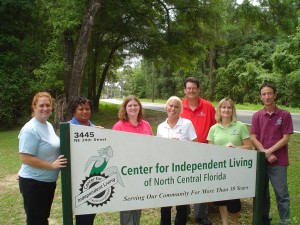
The Center for Independent Living distributes the FTRI phones in Ocala and Marion County. The Center is located at 3445 NE 24th St. in Ocala.

“It’s our responsibility to help promote and educate the community about the services,” Hoffman said.  Anyone in Florida who is a permanent resident, age 3 and older, is deaf, hard of hearing, blind or has a speech disability can qualify for this free equipment.  A variety of models and equipment is available to address particular needs.

For instance, there is a device, called an in-line amplifier, that attaches to the phone. It runs off a 9-volt battery and increases a phone’s volume and tone. And there are land-line phones that also adjust the volume and tone. Three also are loud ringers and visual ringers. Different models contain different decibel ranges. There also are cordless phones. The in-line phones are portable, which comes in handy if there is a power outage.

“You can take it to a hotel, or your family’s house,” Hoffman said.

You can come into the center to fill out an application. No financial or insurance information is required. “We don’t ask about your income,” Hoffman said.  And you can make an appointment to review the equipment to find what is most suitable. “Then we send the equipment home with you that day,” Hoffman said. There is even teletalk equipment for those who have had a laryngectomee and need a speech aid. And for those who cannot hold a handset, there are voice-activated phones.

If you do not live near a distribution center or prefer not to come into the center, you can mail an application to FTRI in Tallahassee. They will mail the phone to you via United Parcel Service or Federal Express, and they will pay the shipping costs. The disadvantage, however, is that the equipment is unassembled and you do not receive training.

If your hearing changes or the equipment malfunctions, you simply contact the distribution center to make  an appointment. They will examine the equipment and, if necessary, provide a new piece of equipment. “For those who are home-bound, we will go out to their home,” Hoffman said, provided there is a doctor’s note to that effect.  According to the 2010 U.S. Census, there were 331,298 people in Marion County. Hoffman said 16 percent of the population, or 53,008 people, have hearing loss.

“We served from July 1, 1991, to Dec. 1, 2011, 14,945 of those individuals,” Hoffman said. Last year, FTRI served more than 2,200 individuals in 16 counties. “It helps keep people connected. It gives them their independence back,” Hoffman said. “We take pride in taking care of our consumers.”

Contact Susan Latham Carr at 867-4156 or susan.carr@starbanner.com

Agency provides phones for the hearing-impaired | Ocala.com.